The Gap Between Intention and Attention — Three Claude workflows that finally close it
The delta between what you planned and what happened is where all the learning lives

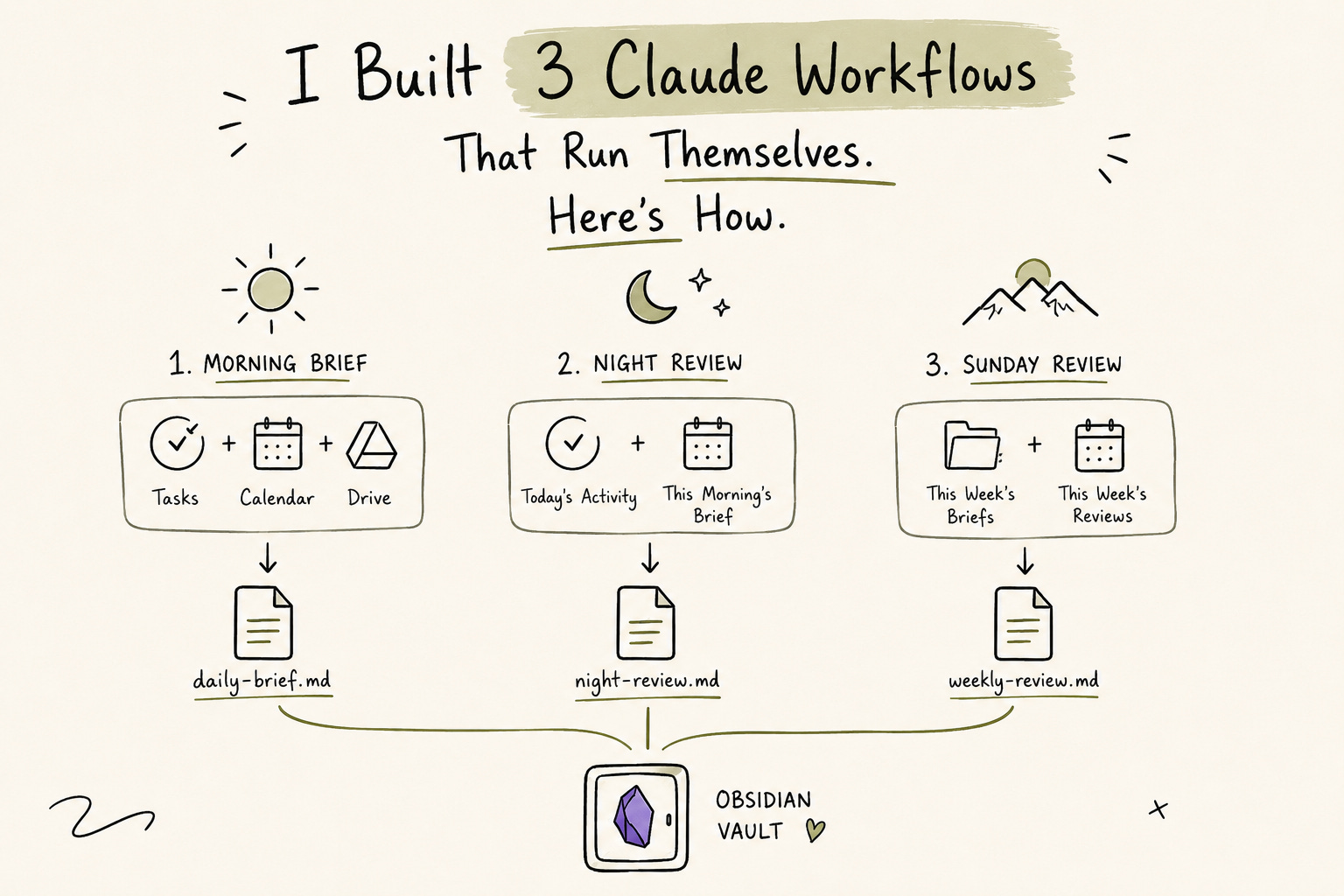
I was watching the Google I/O keynote when they demoed the Daily Brief feature on Gemini and thought — I should just publish my Claude workflows. I’ve been running something like this since scheduled tasks launched, quietly, for myself. Never wrote it up. Today felt like the day.
The setup is simple. I connected Claude to my stack — ClickUp, Google Drive, calendar — and gave it three standing briefs that run on their own. Morning, evening, Saturday.
No triggers, no manual effort. They just happen, and the outputs land in my Obsidian vault as markdown files before I’ve touched anything else.
The problem they solved was one I’d stopped noticing. Every morning I was the integration layer between my own tools. My calendar had my commitments. My task manager had my intentions. My drive had all the context. None of them talked to each other in a way that talked to me. So I did it manually, half-awake, and called it a morning routine.
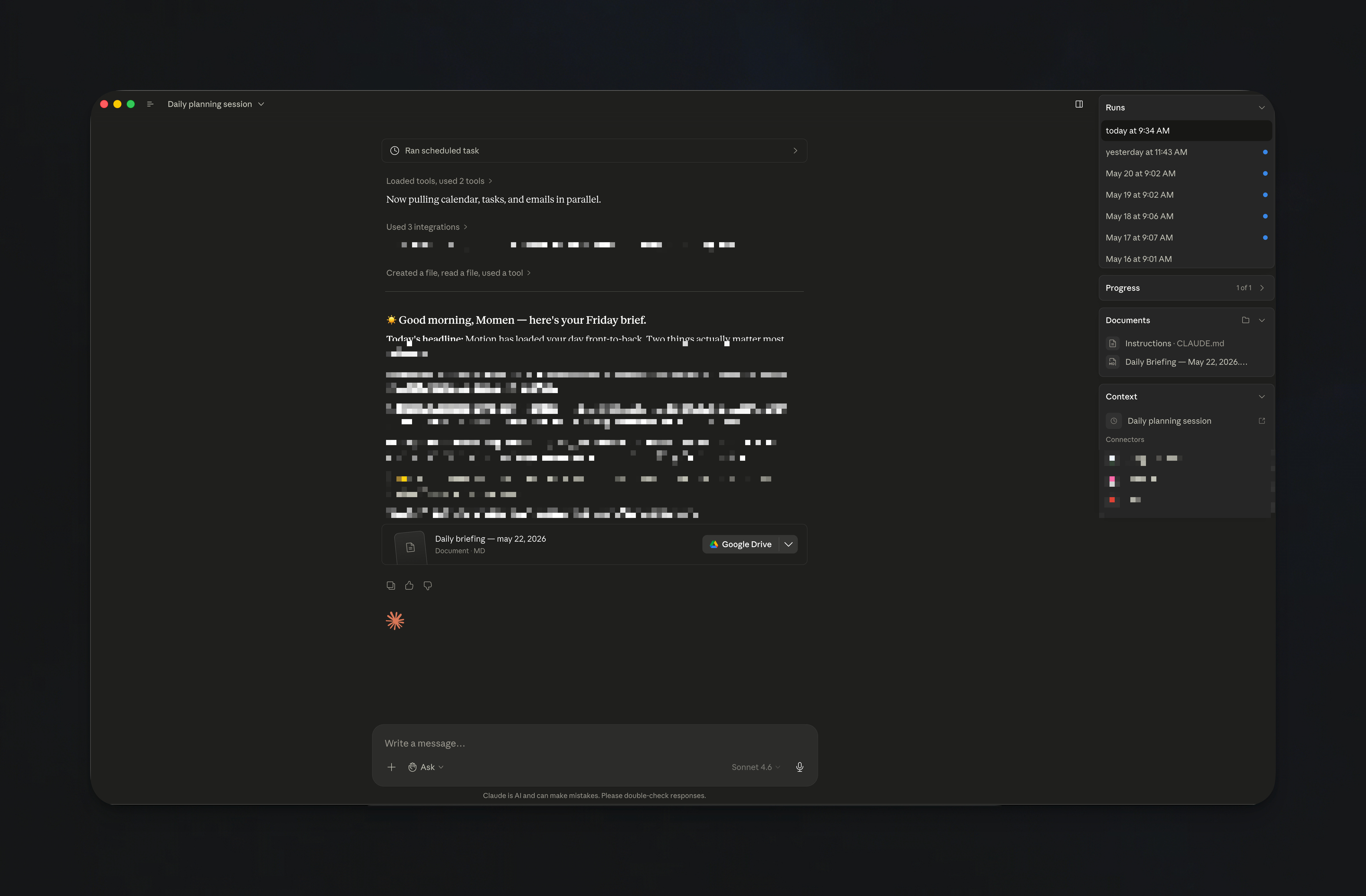
The first brief fixed that. Before I open anything, Claude checks my tasks, scans my calendar, looks for what’s overdue, and gives me a clear picture of the day — three priorities worth protecting and one thing I’ve been sitting on.
That last part matters more than it sounds. There’s a difference between what I think I need in the morning and what I actually need. What I think I need is a summary. What I actually need is someone to tell me what matters and what I’ve been quietly avoiding.
Morning Briefs
Check my ClickUp tasks due today and this week,
scan my calendar for today's events, look for anything
overdue or flagged from yesterday.

Give me 3 priorities I should protect time for,
any conflicts or decisions I'm sitting on,
and one thing I've been avoiding.

Save as daily-brief-[date].md to my Obsidian vault.
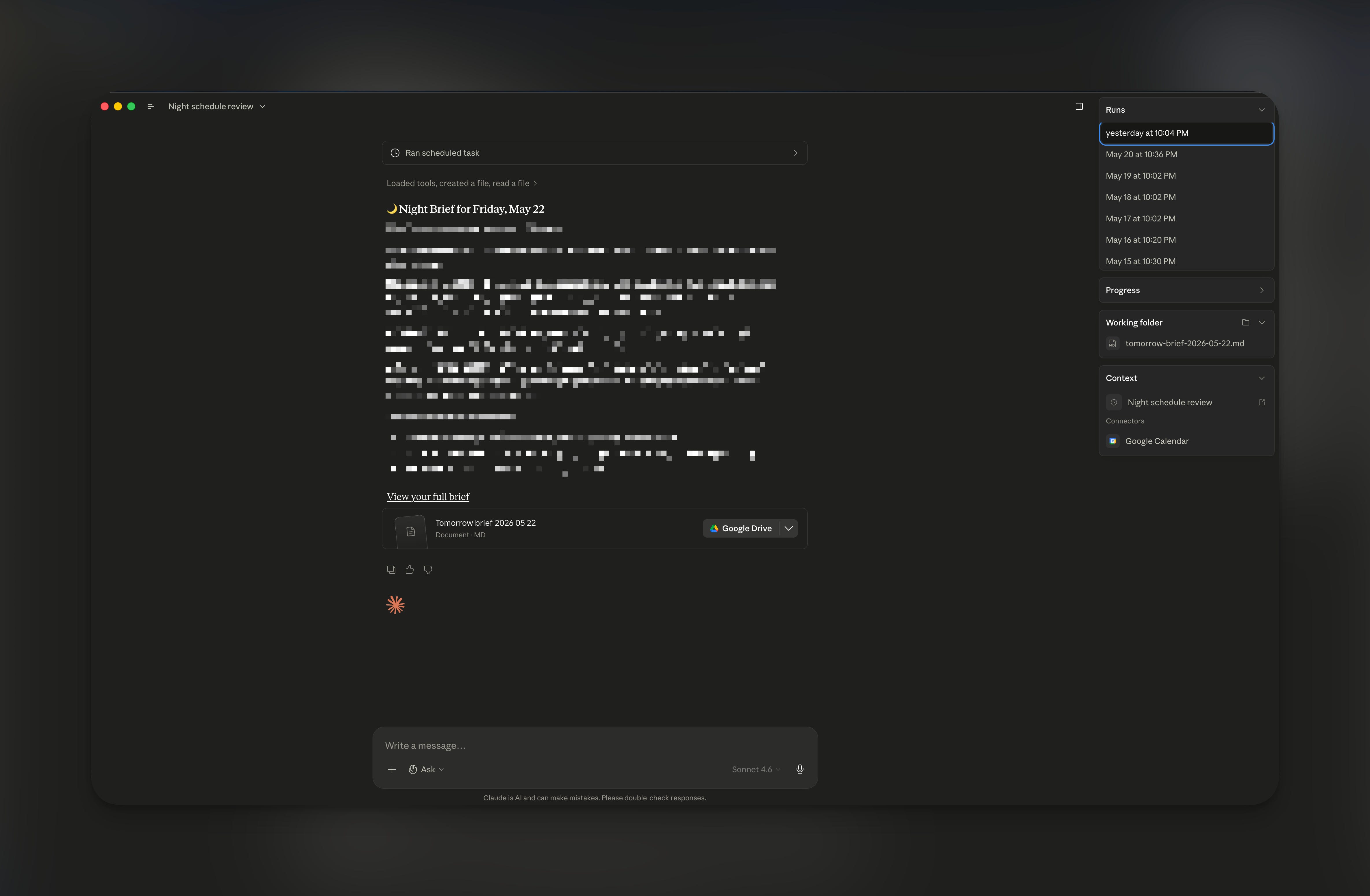
The morning brief alone would just be a nicer dashboard. What made it real was pairing it with a night review. Same idea, different question. Not what should I do but what actually happened. Every evening Claude reads back the day — what moved, what didn’t, how reality compared to the intention I’d set that morning.
Night Reviews
Review my ClickUp activity from today —
what was completed, what moved, what didn't move.
Cross-reference against this morning's brief.

Give me what I said I'd do vs. what I actually did,
any tasks that need to be re-scoped,
and one thing worth reflecting on tonight.

Save as night-review-[date].md to my Obsidian vault.
The delta between those two things — what I planned and what happened — is where all the learning lives. I’d been ignoring it for years.
Seeing it written back cleanly, without judgment, just as fact, is different than knowing it abstractly. The system isn’t calling anything out. It’s just keeping score.
Weekly Reviews
The third workflow came naturally from that. Saturday evenings, Claude reads the whole week — every brief, every review — and reflects it back as a single honest picture. What flowed, what kept getting delayed, what patterns showed up across the days.
Read my daily briefs and night reviews from this week
in my Obsidian vault.

Give me an honest summary of the week's output,
recurring patterns — what kept getting delayed, what flowed,
3 things worth doing differently next week,
and suggested updates to my morning brief prompt
based on what you noticed.

Save as weekly-review-[date].md to Obsidian.
That last instruction — ask it to suggest updates to the prompts themselves — is the one worth stealing. The workflow should evolve with the season of work.
A crunch week needs a different brief than a strategy week. The system should tell you when it’s time to recalibrate, and it will if you ask. I
keep a recurring Saturday reminder to update at least one prompt. Not the whole system. Just one thing.
Prompts that don’t evolve go stale, you stop trusting them, you stop running them, and suddenly you’re back to five dashboards at 8am wondering why nothing feels clear.
What I didn’t expect was what the Obsidian vault would become over time. It started as output storage. It became memory. Months of briefs and honest reviews, all sitting there, searchable, cross-referenceable.
At some point you can ask Claude to scan the whole thing and tell you where your attention actually went versus where you thought it went. That’s not a productivity feature. That’s self-knowledge at a resolution most people never get to see.
I plan well. That was never the problem. The problem was always the gap between the week I designed and the week I actually lived.
These three workflows don’t close that gap. They just make it visible.
And visible is enough.